
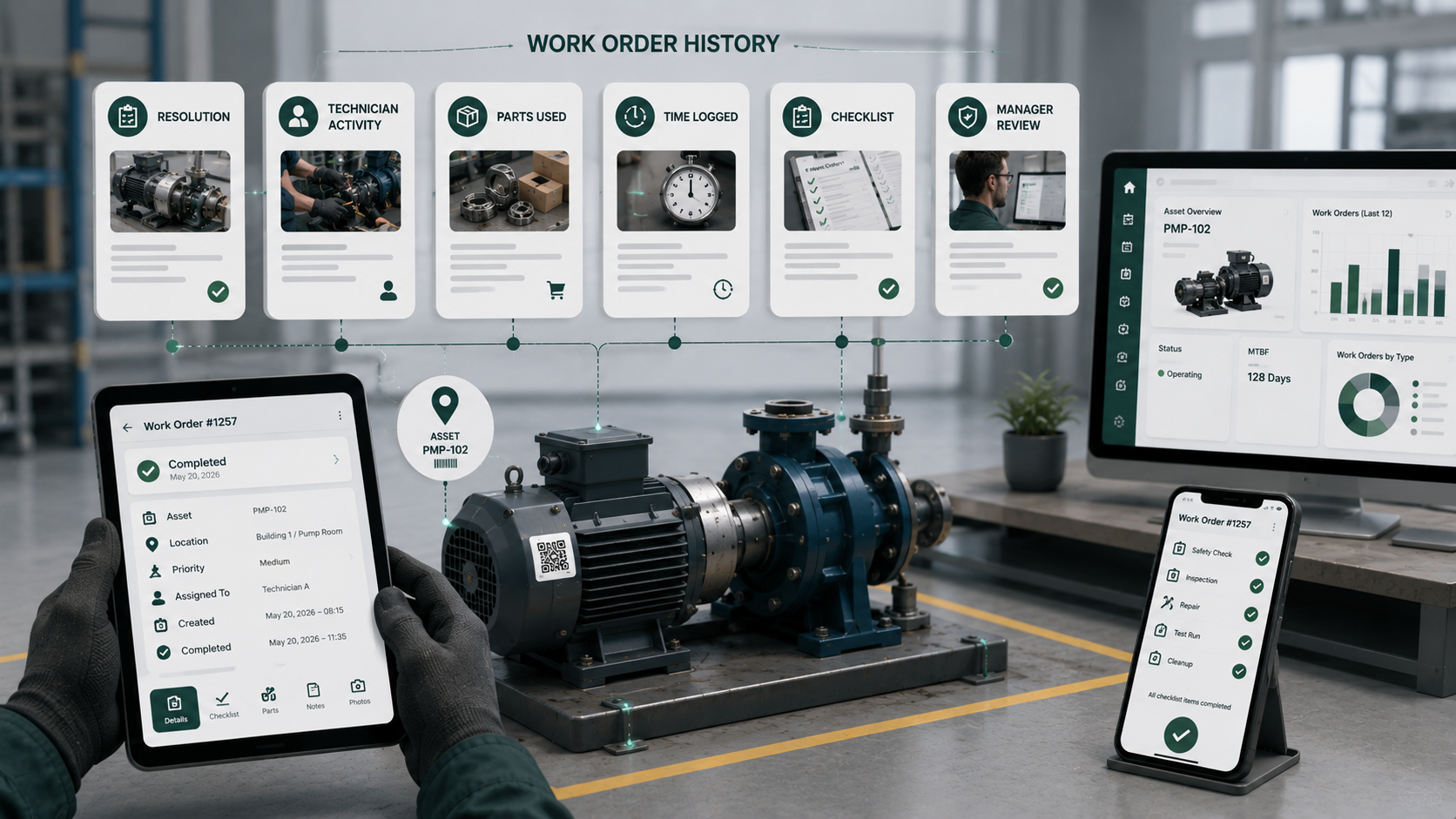
History should serve operations first
Maintenance history is often captured for reporting, but the first audience is the team itself.
If technicians cannot understand past work quickly, and managers cannot see what actually happened, history becomes an archive instead of a tool.
What a useful work order record includes
At minimum, a useful record should show:
- title and context
- asset or location reference
- assignees
- notes and resolution
- time logged
- parts consumed
- checklist completion
Keep resolution notes mandatory at the right moment
If closure happens without a real resolution note, the history becomes shallow immediately. That makes repeated issues much harder to diagnose later.
Multi-assignee work needs one shared record
Lean teams often split execution. One person starts the work, another completes it, and a manager reviews the result. A single operational record avoids knowledge loss across that handoff.
Capture context without turning closure into paperwork
Required fields should protect the usefulness of the record, not create form-filling for its own sake. A short resolution note, the affected asset or location, time spent and parts used are usually more valuable than a long generic report.
Attachments add context when they show the original condition, a nameplate, a measurement or the completed repair. They should support the written record rather than replace it.
Make history useful at the next intervention
The technician opening an asset should be able to answer a few practical questions quickly:
- Has this symptom appeared before?
- What was repaired or adjusted last time?
- Which part was installed?
- Was follow-up work recommended?
- Are there open or overdue activities on the same asset?
This is why work order management software should keep execution details linked to the asset instead of distributing them across comments, files and separate task lists.
Give managers patterns, not just archives
Managers need to filter closed work by asset, location, failure type, assignee, priority and date. The purpose is not to collect a perfect historical database. It is to identify recurring work, weak PM coverage, repeated parts consumption and assets that deserve a replacement discussion.
Common mistakes
- Allowing work orders to close with only “done” as the resolution.
- Storing photos without a note explaining what they show.
- Creating duplicate asset records when names change.
- Recording parts in inventory but not against the intervention.
- Treating history as a management report that technicians never see.
Use the 30-day Liquid CMMS trial to test whether technicians can retrieve and add useful history from the field.
Final thought
Useful maintenance history is concise enough to capture in the field and structured enough to guide the next decision.